

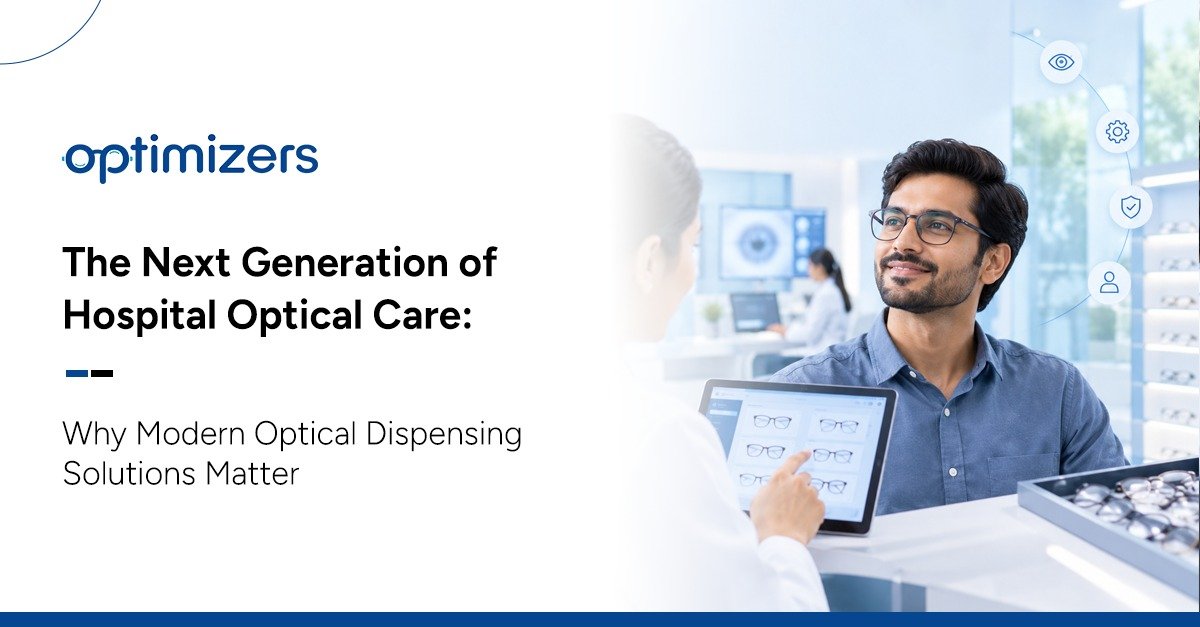
A patient leaves the consulting room with a prescription and a fair amount on their mind. What happens in the next few minutes decides whether that prescription becomes well-fitted eyewear or stays folded in a pocket for weeks. This is where optical dispensing solutions do their quiet, steady work. Hospitals across India are giving this step closer attention, because eye care no longer ends at diagnosis and the optical counter has become an extension of the clinic. This blog explains what modern dispensing involves and why it matters to patients, clinicians and hospital teams.
What Optical Dispensing Really Involves
Dispensing is far more than handing over a pair of glasses. It includes reading the prescription correctly, guiding the patient towards a frame and lens that suit daily routines, taking precise measurements such as pupillary distance and fitting height, and adjusting the finished eyewear until it sits comfortably. In a hospital, the process carries extra weight because the prescription usually comes from a specialist who has just examined the patient. A child with a high refractive error, a senior needing progressive lenses and a patient recovering from cataract surgery each need different care at the counter.
How Dispensing Has Evolved
For many years, optical counters ran on handwritten notes, memory and hard-earned experience. Skilled opticians made that work, and many still do. Patient numbers have since grown, lens choices have multiplied and expectations have risen, so the process now benefits from a little more structure. Modern optical dispensing solutions supply that structure through digital prescription records, standardised measurement tools and defined handover steps. The aim is not to replace the optician’s judgement. It is to give that judgement a dependable framework, so the same quality reaches patients on a crowded Monday and a quiet Thursday.
Benefits for Patients
Accuracy comes first. When measurements are recorded digitally and checked against the prescription, the chance of a gap between what was advised and what is made drops, and patients feel this as eyewear that works from the first day, with fewer trips back for adjustments. Convenience follows closely. A patient who sees the doctor and collects glasses on the same premises saves travel time and avoids carrying a prescription from place to place. For elderly patients and families coming from smaller towns, that matters a great deal.
Benefits for Hospitals and Clinicians
Doctors gain confidence when the prescription they write reaches the patient exactly as intended. A well-organised optical dispensing solution for hospitals supports this through clear communication between the consulting room and the optical counter, along with records that are easy to revisit at follow-up visits. For administrators, the gains are quieter but steady. Smoother patient flow, better stock visibility and consistent service standards all add to the overall patient experience, which is increasingly viewed as part of clinical quality itself.
What to Look for in a Modern Dispensing Setup
A few elements deserve attention: certified opticians, a frame and lens range that suits the hospital’s patient mix, reliable fitting and measurement equipment, and a workflow that links the consulting room with the dispensing counter. Staff training matters most, since technology works best in skilled hands. After-sales care is worth a look too. Follow-up adjustments, repairs and re-checks for children and older adults keep patients connected to the hospital long after the first pair is delivered, and setups that plan for this tend to earn lasting trust.
Conclusion
Eye care is a journey that begins in the consulting room and ends when the patient sees clearly through well-fitted eyewear. Modern dispensing practices connect those two points, and that connection makes the real difference to how patients feel about their care. As hospitals plan the next stage of their patient services, choosing an optical dispensing solution for hospitals built on accuracy, trained people and patient comfort is a sensible step. It protects the clinician’s work and gives patients a result they can feel every day.
FAQs
What are optical dispensing solutions?
They are the systems, tools and trained people that turn a prescription into properly fitted eyewear, covering measurement, frame and lens guidance, fitting and adjustment.
Why do hospitals need a structured dispensing process?
Patients often arrive with complex prescriptions. A structured process keeps what the doctor advises and what the patient receives closely aligned.
Who handles optical dispensing?
Qualified opticians or optometrists, who read the prescription, take measurements and fit the eyewear.
How do digital measurements help?
They reduce manual errors and keep a record of pupillary distance, fitting height and lens details, which makes follow-up visits and remakes easier.
Is dispensing important for children and older adults?
Yes. Children need frames that stay in place and suit growing faces, while older adults often need progressive or multifocal lenses fitted with care.
How long does the dispensing process take?
It depends on the prescription. Simple single-vision eyewear can often be completed quickly, while specialised lenses may need additional time for preparation and fitting.