

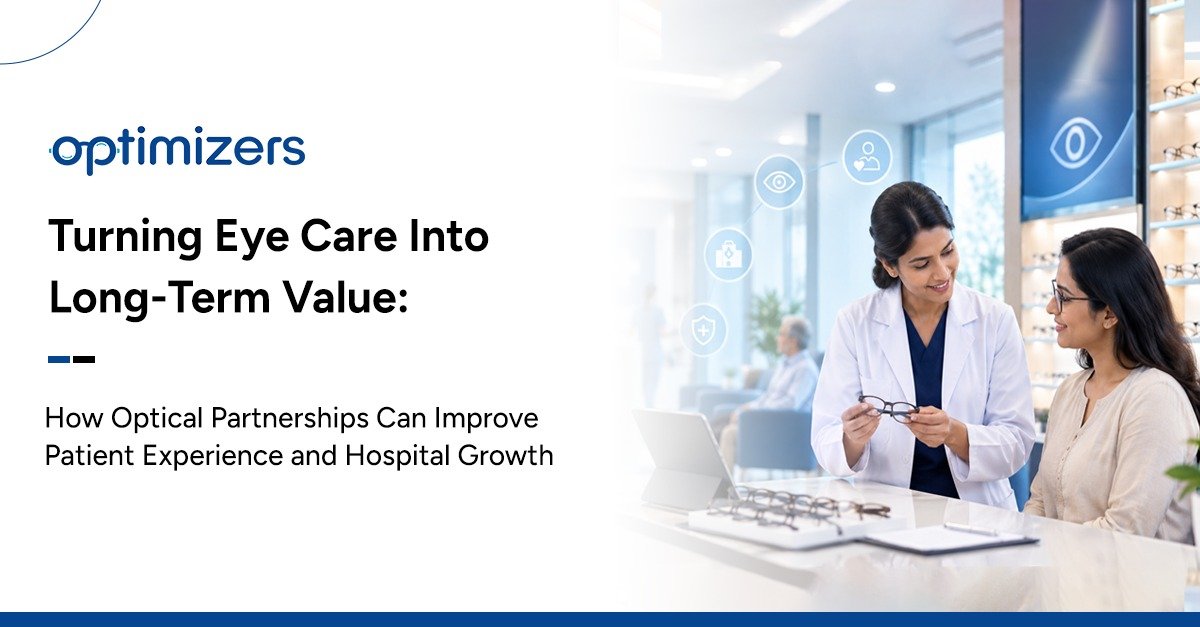
Walk into most eye hospitals today and you’ll notice something interesting. A patient gets diagnosed, receives a prescription, and then leaves to buy glasses somewhere else entirely. The hospital did the hard clinical work, but the value of that visit walks out the door with the patient.
This gap between diagnosis and dispensing is where a well-structured eye hospital revenue optical partnership can change the story for both the hospital and the patient.
Why the Gap Exists in the First Place
Most eye hospitals were built around clinical excellence: surgeons, diagnostics, treatment protocols. Optical dispensing was never the core focus, and understandably so. Managing frame inventory, lens fitting, staff training, and vendor relationships requires a completely different skill set than running an ophthalmology department. So hospitals either skip optical services altogether or offer a small, underused counter that never gets the attention it needs.
Patients aren’t choosing to go elsewhere out of dissatisfaction. They simply don’t see a compelling reason to stay when the in-house optical counter feels like an afterthought rather than a natural next step in their care journey.
What a Real Partnership Looks Like
A functional optical partnership isn’t about placing a display case in the lobby and hoping for the best. It works when a dedicated partner brings the operational backbone (sourcing, inventory planning, trained opticians, and a smooth billing flow) while the hospital keeps its focus on clinical care. The two sides complement each other instead of competing for attention.
This kind of setup also changes the patient experience in a quiet but meaningful way. Instead of leaving with a piece of paper and a vague plan to “get glasses later,” the patient can walk from the consultation room straight to a proper fitting, guided by someone trained specifically for that handoff. It closes a loop that used to stay open.
Where the Revenue Actually Comes From
The financial upside isn’t a single lump gain. It builds from a few consistent sources. Every prescription generated within the hospital becomes a potential dispensing opportunity instead of a missed one. Follow-up visits, especially for children and elderly patients who need frequent lens adjustments, create repeat footfall. And because the optical counter operates under the same roof as the diagnosis, trust transfers naturally. Patients are far more likely to complete a purchase somewhere they already feel confident in.
Over time, this steady conversion of existing patient volume tends to matter more than chasing new footfall from outside. The hospital doesn’t need more patients to see a difference. It needs to capture more value from the patients it already has.
Making the Model Sustainable
None of this works as a one-time setup. What actually increases optical sales in eye hospital settings over the long run is consistency: staff who understand both the clinical context and the product side, inventory that reflects what the hospital’s specific patient base actually needs, and a feedback loop where doctors and opticians are talking to each other, not operating in silos.
Training matters here more than most hospitals expect. An optician who understands why a particular lens coating was recommended for a post-surgical patient can explain it far better than one working purely off a sales script. That kind of alignment doesn’t happen by accident. It needs a partner who treats the hospital’s clinical standards as the starting point, not an obstacle to work around.
Conclusion
Eye hospitals don’t need to become experts in optical dispensing to benefit from it. What they need is a partner who can carry that operational weight while respecting the clinical environment the hospital has already built. When that balance is right, the hospital sees a more complete patient journey, patients get a smoother path from diagnosis to a finished pair of glasses, and the numbers follow naturally from better-served patients rather than aggressive upselling. It’s a shift in how existing care is completed, not a departure from what the hospital already does well.
FAQs
Do eye hospitals need to hire their own optical staff to make this work?
Not necessarily. Most successful setups bring in trained opticians through the partnership itself, so the hospital doesn’t have to build that expertise from scratch or manage a separate hiring process.
Will an optical partnership change how the hospital's clinical space feels to patients?
No, a well-run partnership fits into the existing patient flow rather than reshaping it. The clinical experience stays the same; only the path after diagnosis becomes more complete.
How long does it typically take to see a difference in patient conversion?
It varies by hospital size and patient volume, but most see a noticeable shift within a few months once staff training and inventory alignment are in place.
Is this model only useful for large, multi-specialty eye hospitals?
Smaller hospitals and standalone eye care centers can benefit just as much, sometimes more, since every patient interaction carries proportionally more weight for them.
What happens to patients who prefer to buy glasses elsewhere?
Nothing changes for them. The goal isn’t to restrict choice but to make staying a genuinely easier and more informed option for those who want it.
Does this require a major upfront investment from the hospital?
Typically, the operational and inventory investment sits with the optical partner, which is one of the reasons this model works well for hospitals that want the benefit without taking on new overhead.