

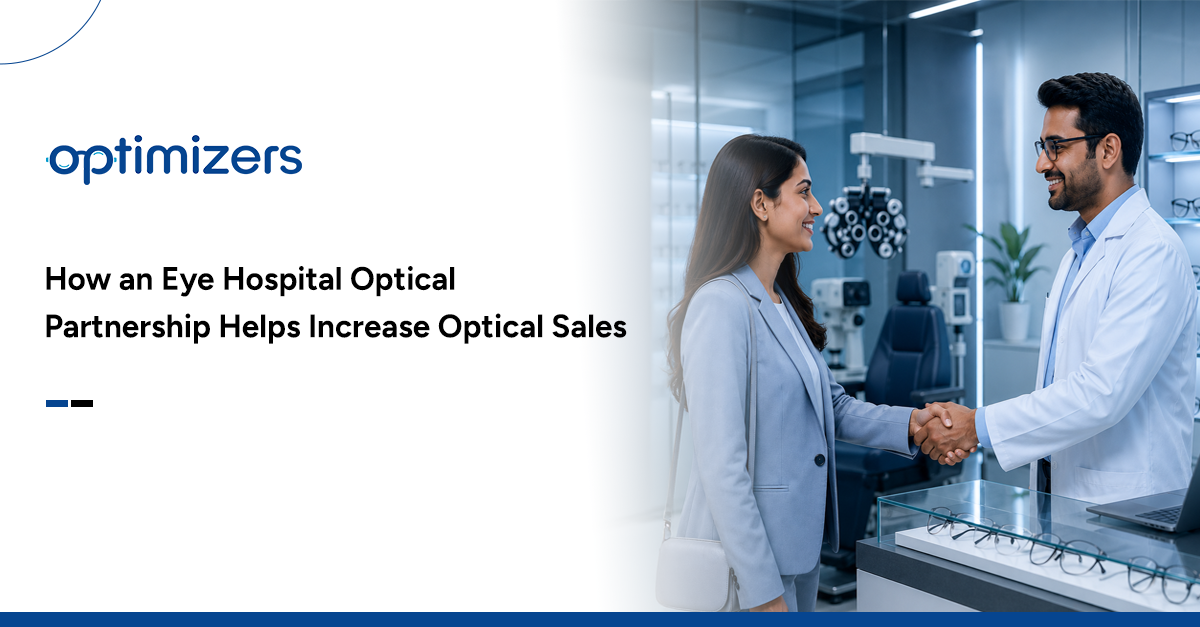
A patient walks out of an eye examination holding a fresh prescription. At that exact moment, they are more ready to buy the right pair of glasses than they will be at almost any other point. This is the idea behind an increase in optical sales in eye hospital settings, where the clinical side of eye care joins the retail side, so a patient’s visit does not stop at diagnosis but carries through to a properly chosen pair of eyewear.
What This Partnership Actually Means
An eye hospital revenue optical partnership is an arrangement where a hospital and an optical retail team coordinate closely instead of operating as two unrelated services under one roof. The hospital handles examination, diagnosis, and treatment as usual. The optical team takes over from there, handling frame selection, lens fitting, and dispensing. Both sides share in the revenue this generates, which gives the hospital reason to support the arrangement and gives the optical partner a steady stream of patients who already know exactly what their eyes need.
The real advantage here is context. The optical staff are not meeting a stranger with no background. They already have the prescription in hand, they know why the patient came in, and often they know what specific concerns the doctor raised during the consultation.
Why This Setup Leads to More Optical Sales
Most patients leaving a consultation are not unsure about whether they need glasses. What usually stands between them and a purchase is delay. Carrying a prescription to a different shop, comparing a few stores, and coming back another day all create room for the purchase to simply not happen. When the optical section sits within the same visit, none of that gap exists, and a patient is far more likely to leave with new glasses already in hand. This is where hospitals begin to see a genuine increase in optical sales in eye hospital settings.
Trust adds to this. A recommendation coming from staff connected to the same hospital where a patient was just examined tends to carry more weight than one from an unfamiliar shop. It reads less like a sales pitch and more like a continuation of what the doctor already told them. That trust often speeds up the decision considerably.
Accuracy matters too, though in a quieter way. Staff working inside a hospital setting usually understand clinical language and specific lens requirements better than staff at a general optical shop would. That understanding lets them point patients toward frames and lenses that genuinely fit their prescription and daily needs, instead of offering whatever happens to be popular that month. Patients who feel properly guided tend to come back the next time they need glasses, rather than starting their search elsewhere.
Then there is word of mouth, which is easy to overlook but does more work than most people expect. A patient whose entire visit felt connected, from the eye check up to walking out with prescribed new glasses, is likely to mention that experience to a friend or family member. Over months and years, this kind of informal recommendation often drives more optical sales than any single planned effort.
What Hospitals Should Pay Attention To
Picking the right optical partner is not something to rush. A partner who understands how a hospital operates, who respects the accuracy of a prescription, and who trains staff to speak with patients the way clinical staff do will make the whole arrangement feel like one connected service rather than two businesses sharing a lobby. Keeping communication open between doctors and optical staff also helps, especially for patients whose visual needs go beyond a standard prescription.
Conclusion
An eye hospital revenue optical partnership works best when it is treated as part of patient care rather than as a separate business activity bolted onto the hospital. When examination and eyewear selection happen in the same trusted space, patients feel more confident, purchases happen with less friction, and hospitals see a revenue stream grow out of genuine patient satisfaction rather than any kind of push selling. For hospitals looking to increase optical sales in eye hospital settings, this integrated approach tends to outperform standalone retail efforts, simply because the trust built during a clinical visit carries over into the purchase decision.
FAQs
What does an eye hospital revenue optical partnership actually involve?
A hospital and an optical retail team work together so patients can move from eye examination straight to eyewear selection in the same visit, with the revenue from optical sales split between both sides.
Does this kind of partnership change how patients are examined or treated?
Not at all. Examination and diagnosis stay entirely separate from this arrangement. The partnership only comes into play once the clinical part of the visit is done.
Why do patients tend to buy eyewear more readily under this model?
Patients generally trust suggestions made within the same clinical space where they were just examined, and being able to finish their purchase in one visit removes the delay that often leads to a postponed or skipped decision.
How does an optical partner benefit from being connected to a hospital?
The optical partner gets a steady flow of patients who already have a confirmed prescription and known visual needs, which means more accurate and relevant suggestions right from the first conversation.
What should a hospital look for when choosing an optical partner?
A hospital should look for a partner who understands how clinical workflows operate, respects the accuracy of a prescription, and trains staff to speak with the same expertise as the hospital’s own team.
Can this kind of partnership improve patient retention over time?
Yes. Patients who go through a well guided, connected experience are more likely to return for future eyewear needs and to speak well of the hospital and its optical services to people around them.